

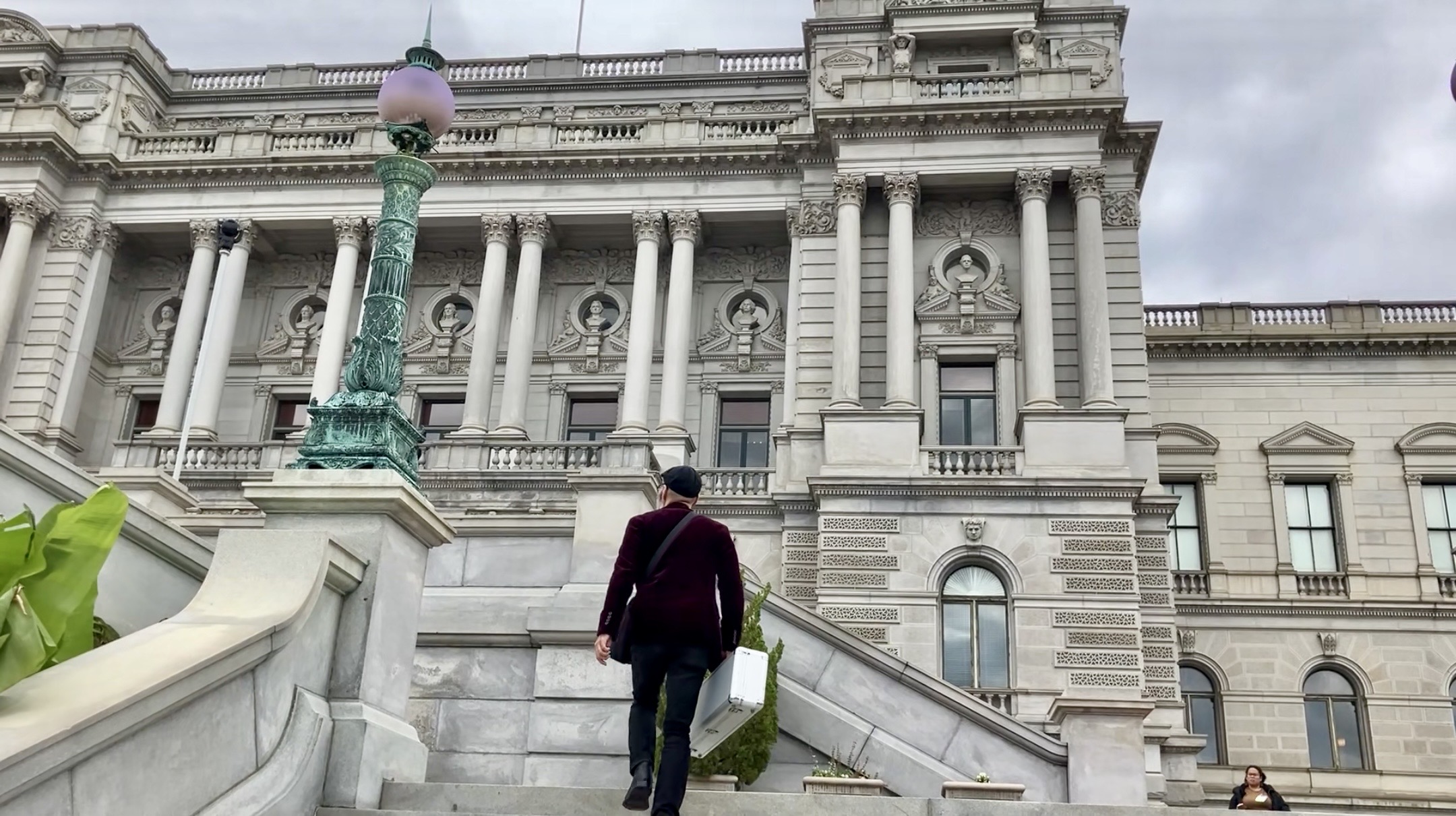
For Henry Lien, becoming a writer was the major plot twist that changed his life. The UCLA Extension instructor pursued his interest in non-Western storytelling structures, which led to writing a book on the subject that recently garnered the attention of the Library of Congress and presented the opportunity to travel to Washington, D.C. On Sept. 24, Lien performed for a packed house as part of the Live! At the Library series, a culmination of years of following his muse and imparting his wisdom to students.
“It was a presentation that engaged the mind and engaged the heart,” he said. “We laughed and cried. And it was one of the most memorable nights of my life.”
Lien, a Taiwanese immigrant, attended UCLA School of Law and practiced as an attorney for 10 years before transitioning into art dealing. He was able to combine those two areas of expertise for UCLA Extension by creating a curriculum on interior design law that he has taught for about a decade. While at UCLA Extension, Lien was inspired by its Writers’ Program and its transformational outcomes for students. As an Angeleno, the dream of making it creatively always tugged at him.
“One day, when I was 42 years old, I looked in the mirror and saw a middle-aged man with a receding hairline. I snapped and came out openly as an aspiring writer,” he said with a laugh. “Everyone here is hyphenated – it’s part of the culture here. People respect it and applaud it. So I became part of this great stream of dreamers, many of whom come through UCLA Extension and its beautiful model of getting there from here.”
Lien began to develop a name for himself as a writer, first through his books in fantasy and science fiction, but then also in his ability to decipher and translate the art of storytelling. Specifically, he developed a course for the Writers’ Program titled Non-Western Storytelling Structures, Themes and Values. That led him to write the book, “Spring, Summer, Asteroid, Bird: The Art of Eastern Storytelling,” that gained the attention of the Library of Congress.
“There is not one universal way to tell a story,” Lien said. “That is why books and films and gardens and architecture around the world are so very different. It’s not just by accident. UCLA Extension has served as a launchpad for my national discussions of this topic.”
Non-Western storytelling is less restrained to formula. It can build stories where there is no villain or conflict. The genre of the story can, and often does, change after the halfway point.
“It’s a next level discussion about cultural difference in a way which is wholly positive,” Lien said. “It’s not about identity politics. It’s not about zero-sum policies made by lawmakers. It’s just about celebrating anime, video games and films like ‘Parasite.’ This is a way to embrace cultural difference in a way that is positive, constructive, illuminating and not about arguing, which I think we’ve all had enough of.”
Lien received a tour where staff brought out items from the Library of Congress collection including 1860s Japanese manga and newsletters from Chinese American soldiers from the 1940s. They even had several of Lien’s books.
“The idea that this kid from Taiwan, who came to this country speaking no English, could get his books in the collections of one of the great libraries of human civilization was particularly meaningful to me,” he added.
Revelers then gathered for a cocktail party before giving way to presentation by Lien titled, The Beauty of Eastern Storytelling. The room was full and brimming with enthusiasm.
“I felt like Cinderella at the ball,” Lien said. “I was treated to a magical experience.”
Lien wove his storytelling expertise with personal stories touching upon his father’s evolution later in life and a tribute to his soulmate who passed away when he was younger. He very deliberately mentioned UCLA Extension, a place he gives credit to for his mid-life reinvention, and a place he sees as giving opportunity to many others, as well.
“The reason UCLA extension means so much to me is because of this idea of reinvention,” Lien said. “It is never too late to reinvent yourself. It is never too late to take the path not taken. It is never too late to tell the story that has been sitting inside you for 50 years. And I am also trying to help people find the surprise twist in the middle of their story.”


