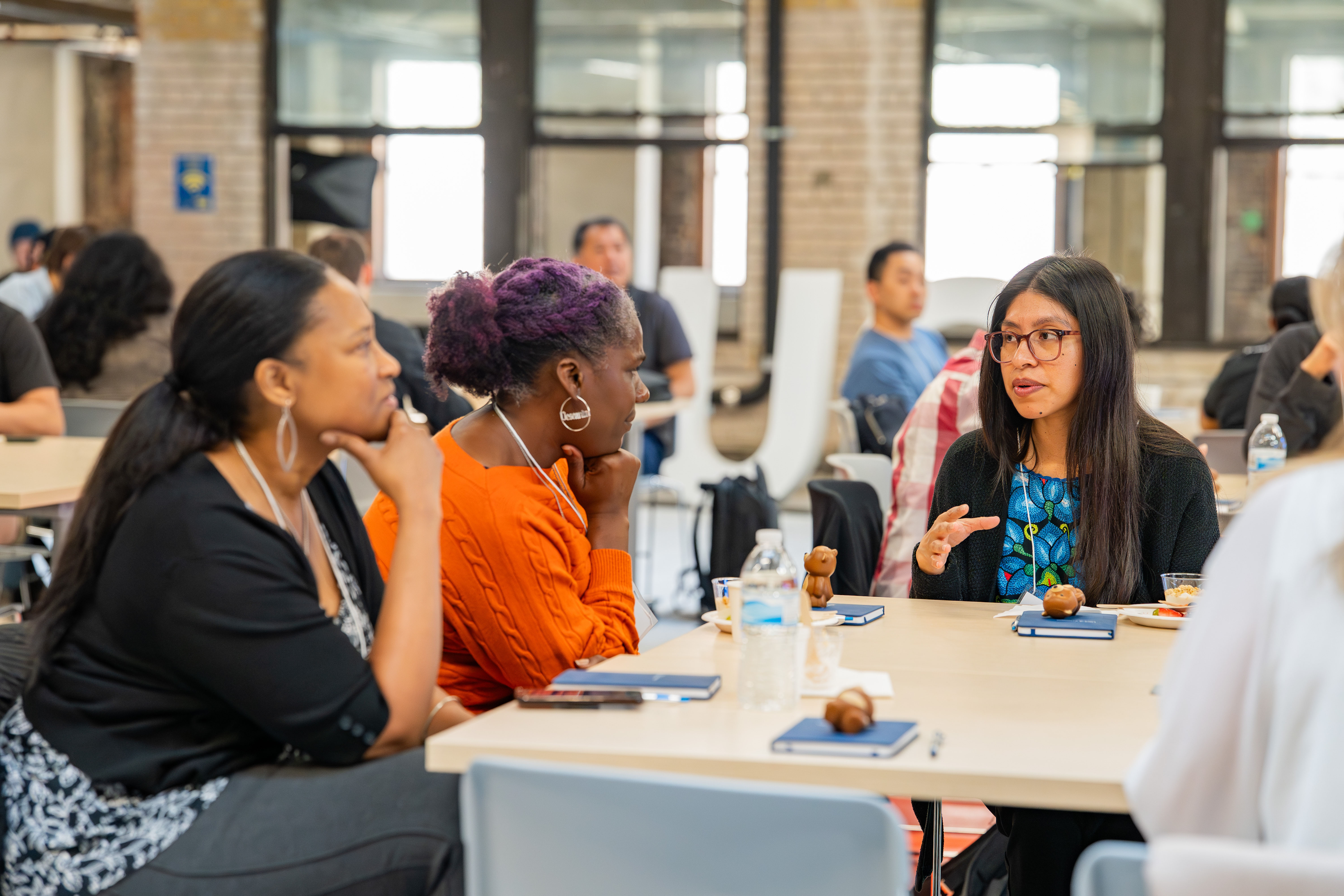
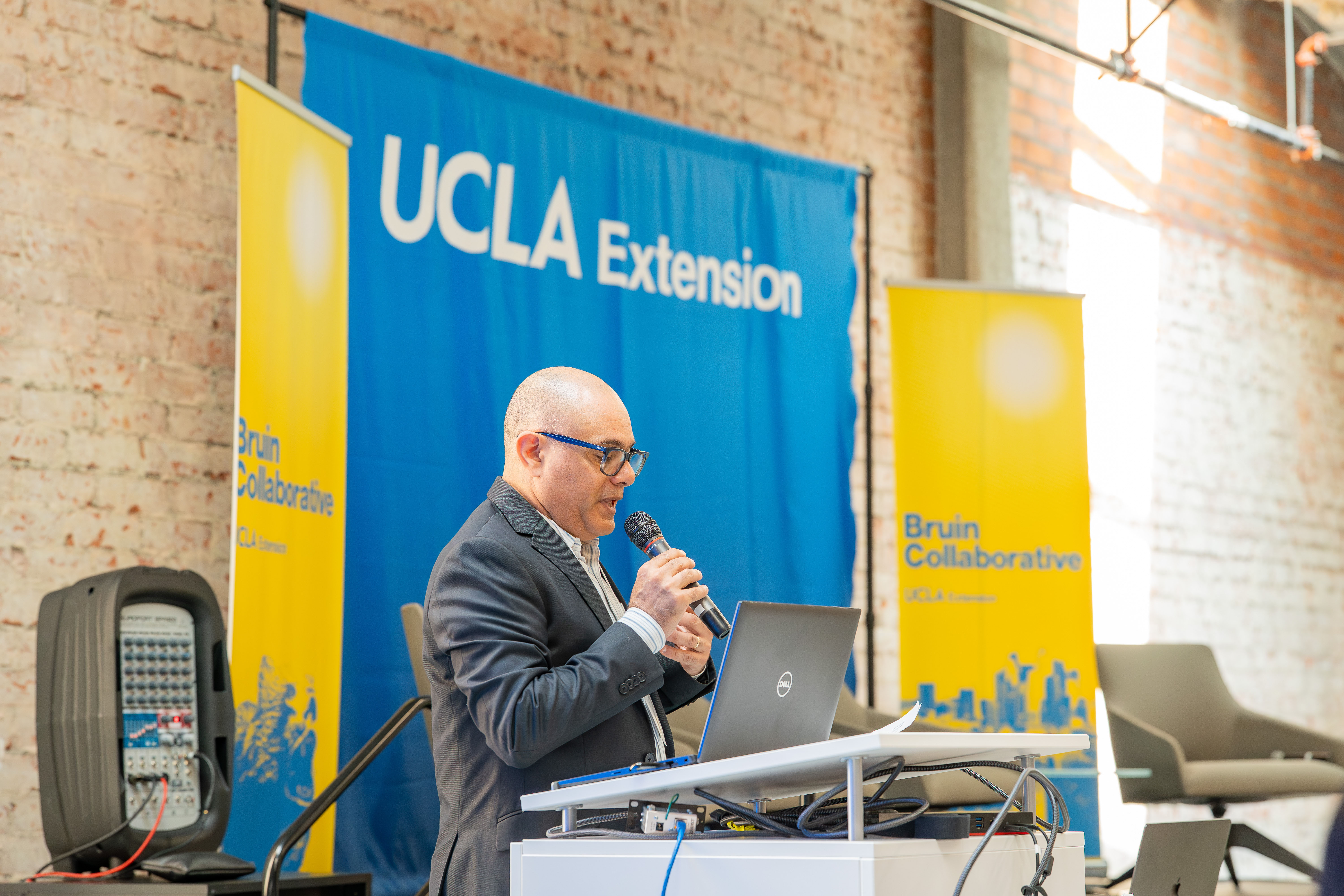
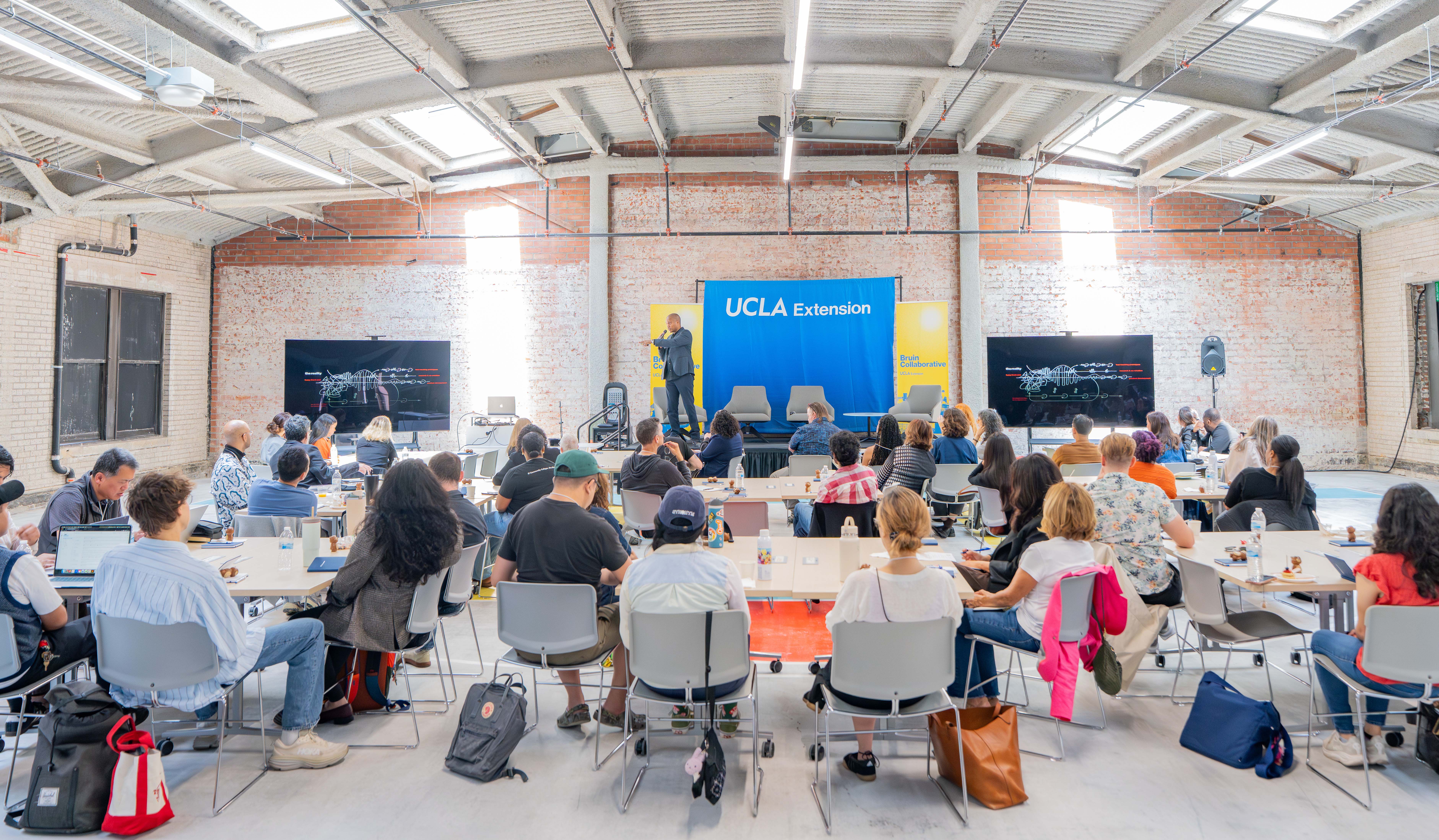
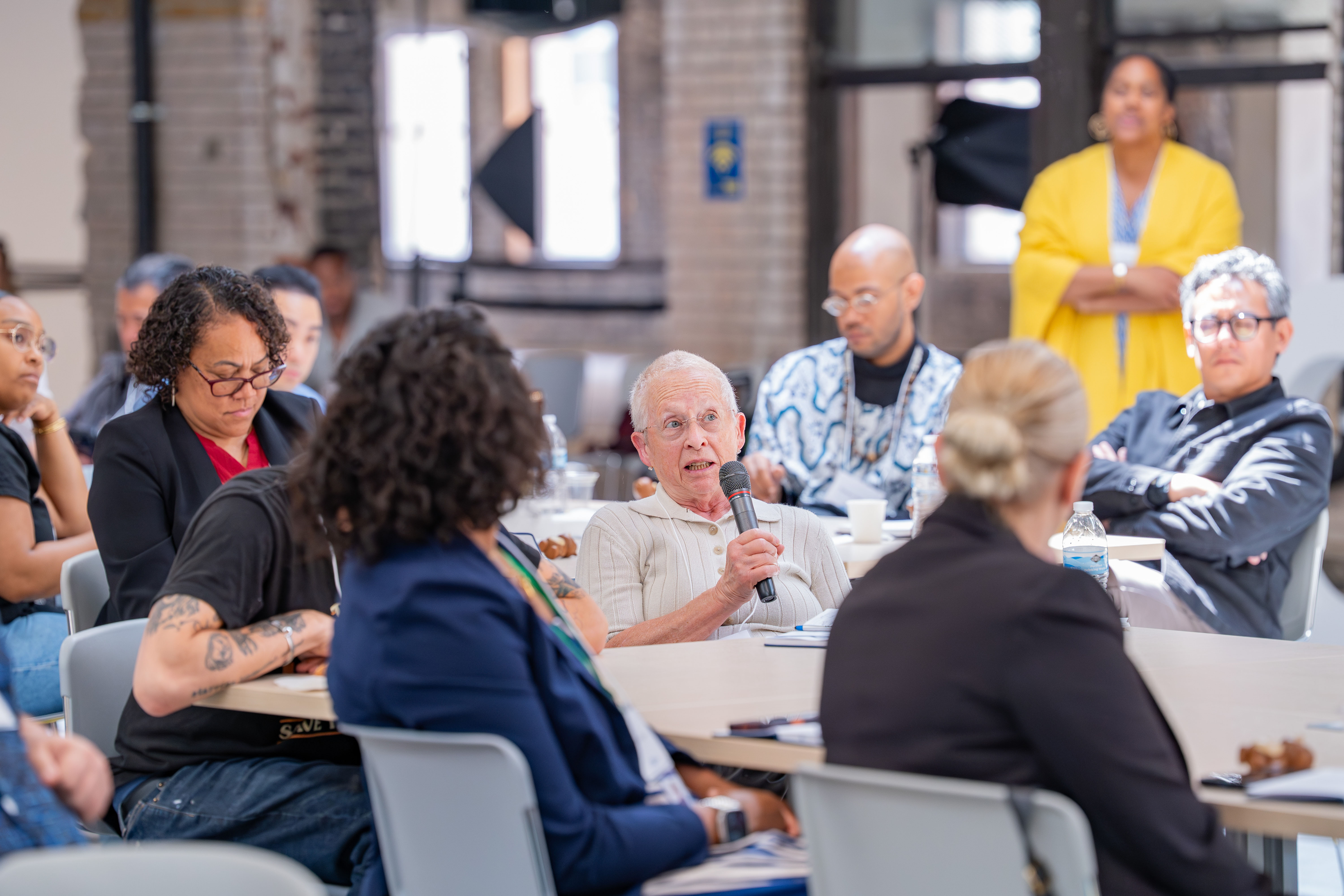
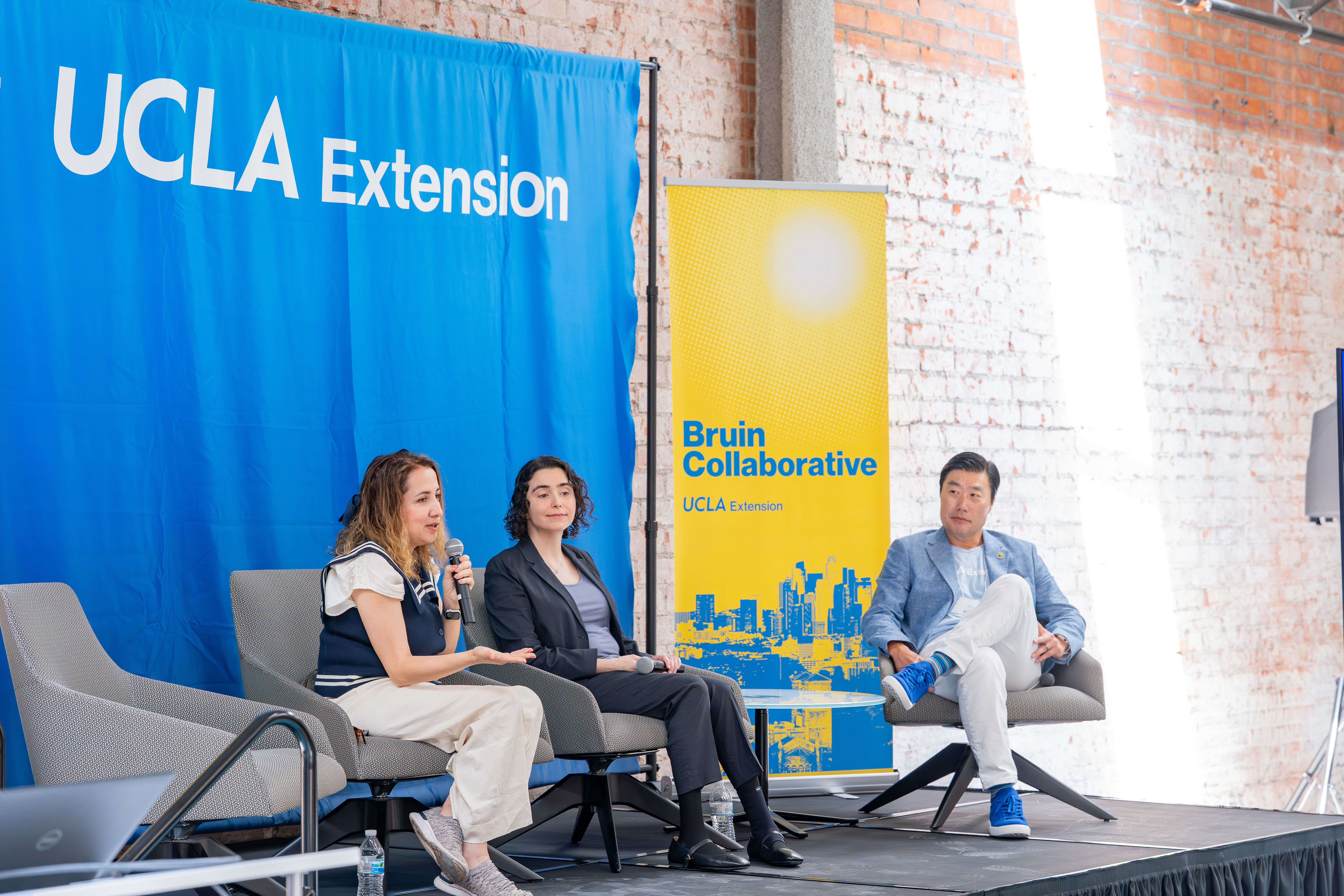
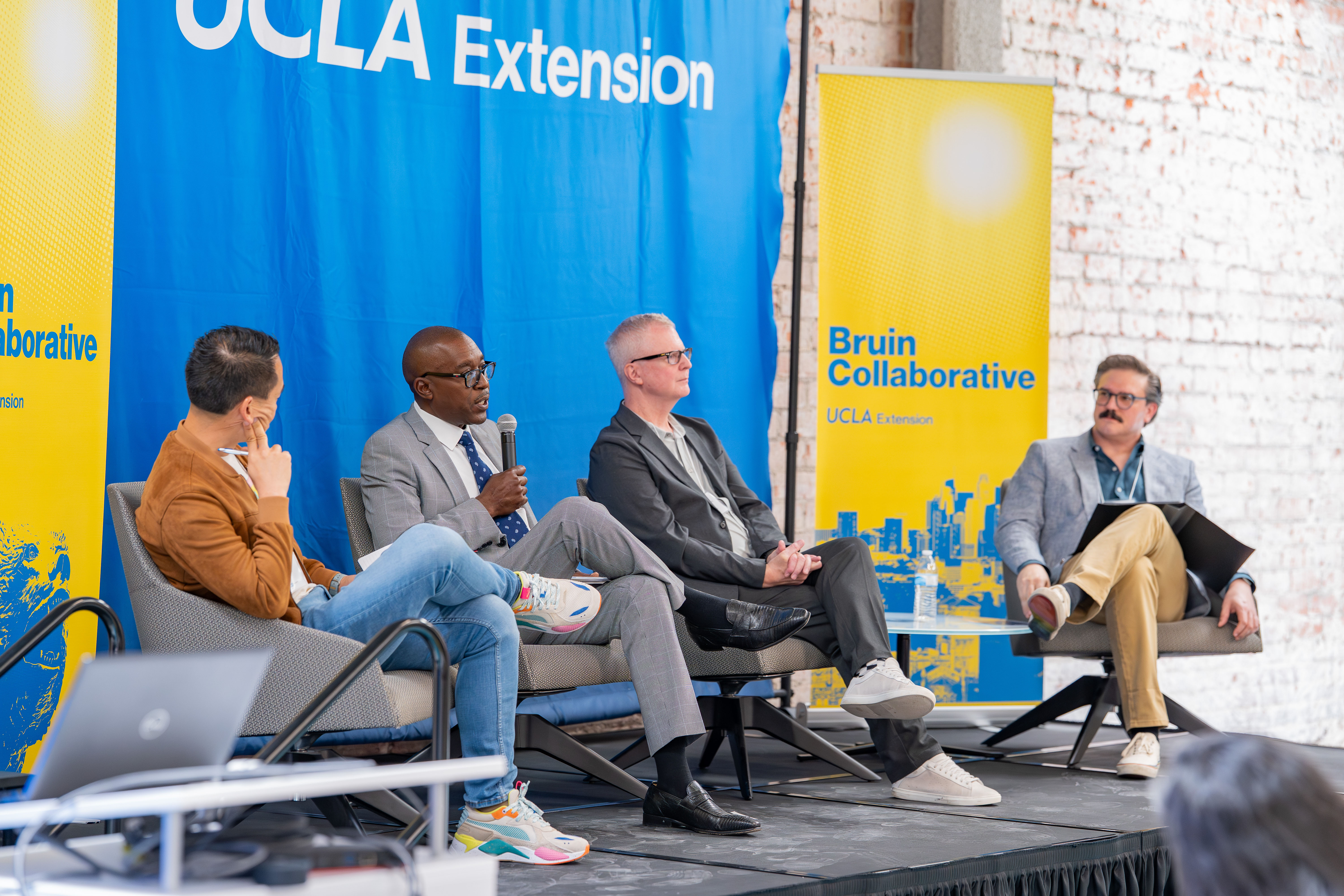
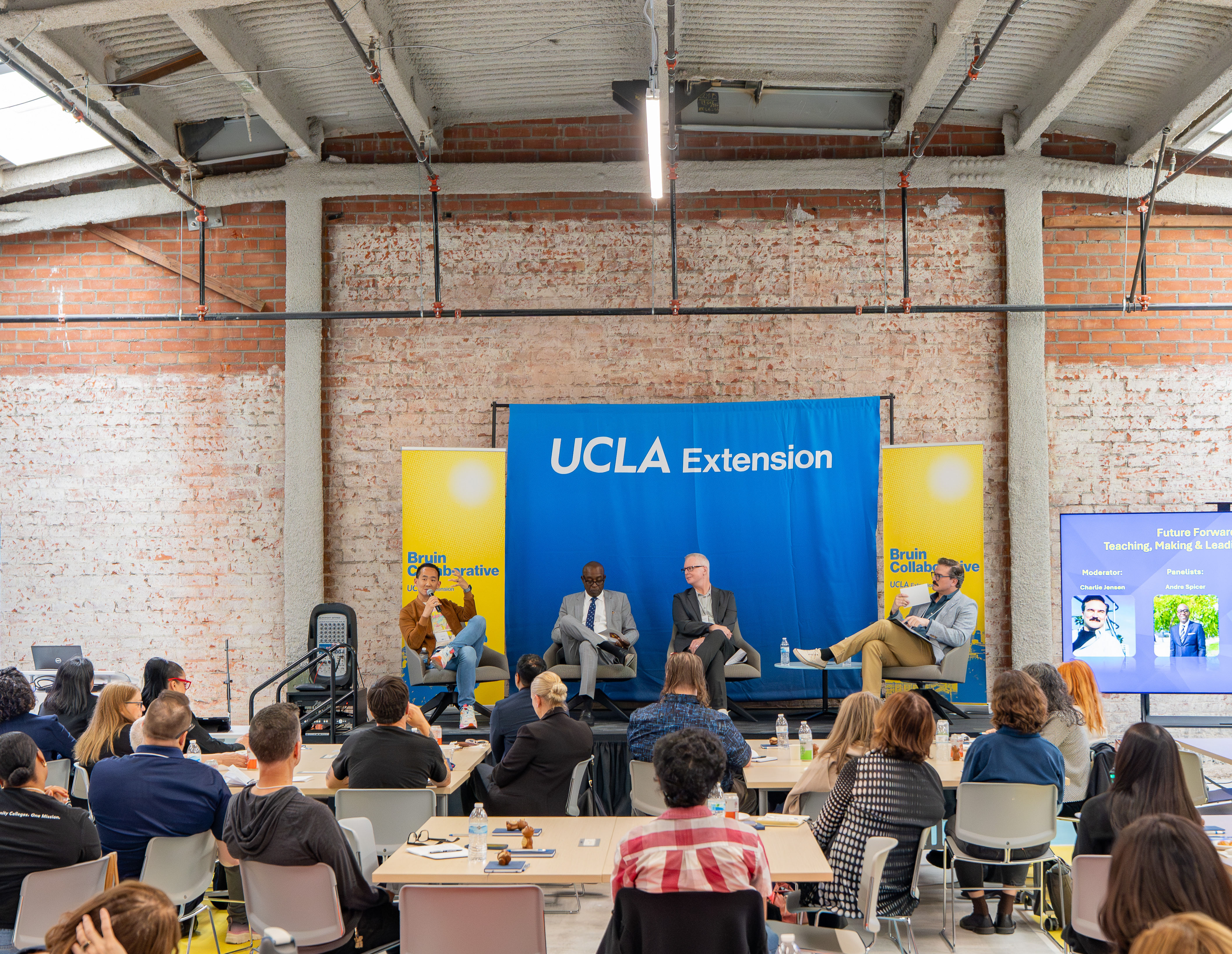
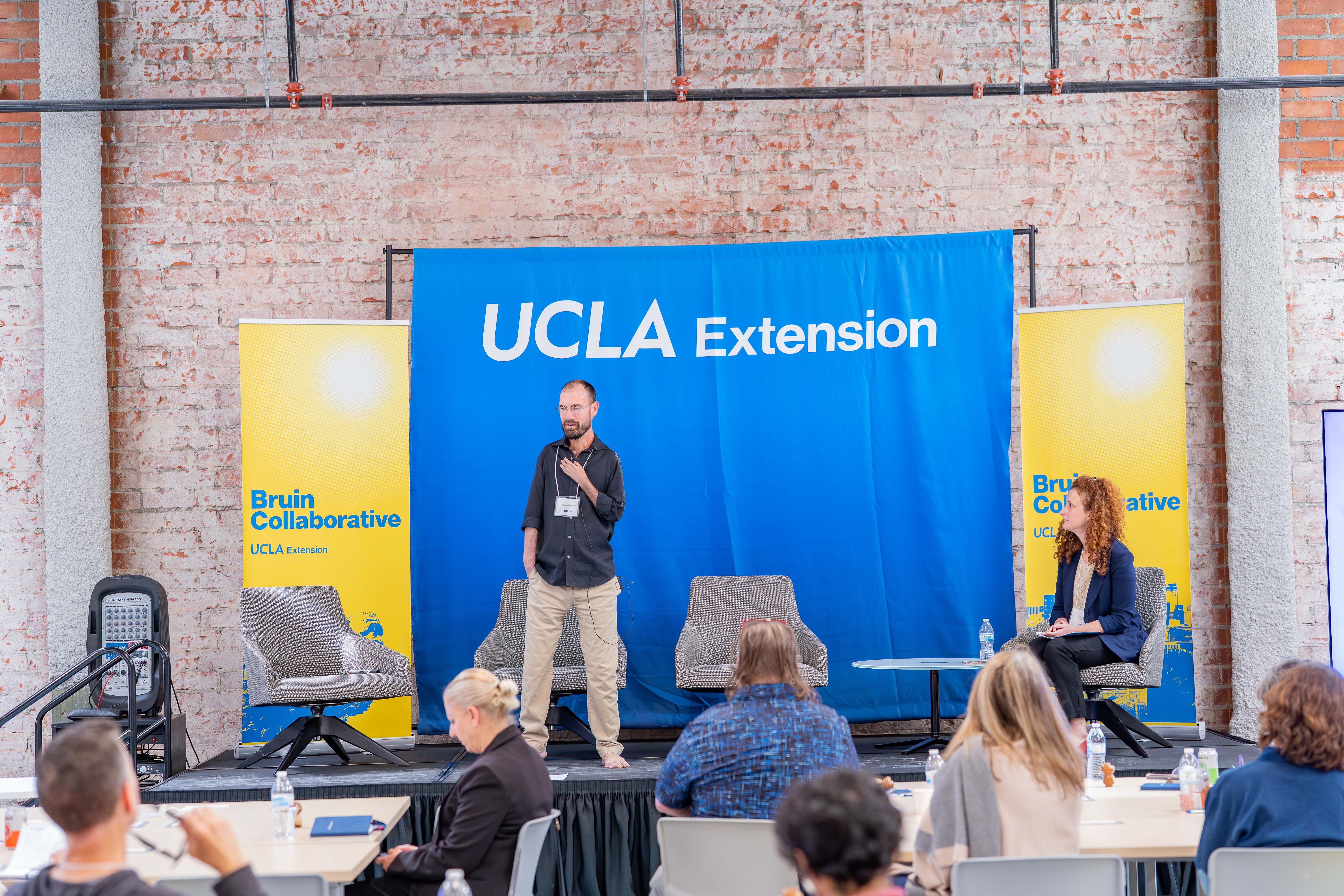
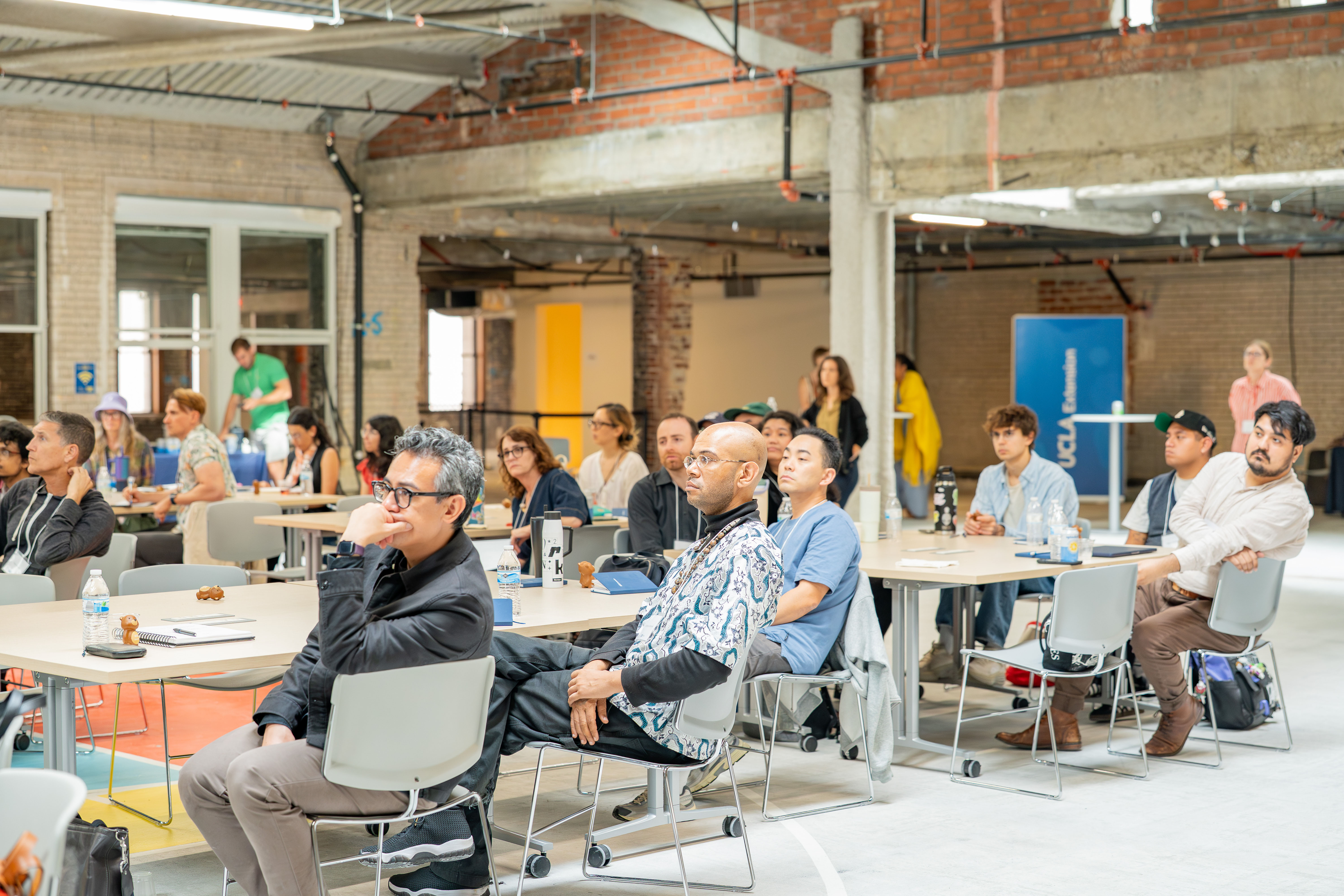
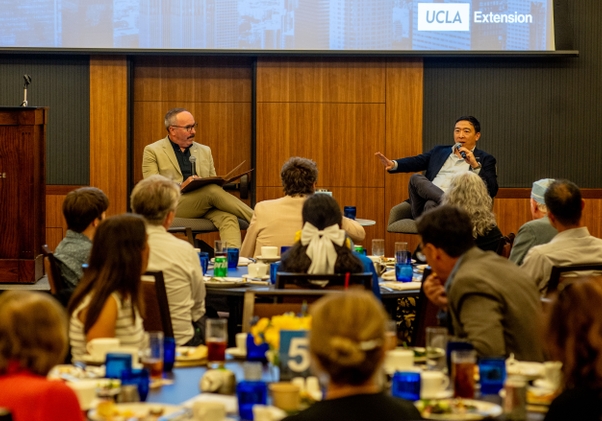
More than 60 designers, artists, students, educators and creative leaders gathered at UCLA Downtown, sitting at communal tables ready to tackle what the future holds for arts and education – specifically at the intersection of the two – for the inaugural RE:DESIGN // RE:IMAGINE Summit.
“We did not ask you for your affiliation or other identifying information because we want you all to truly be in community with each other – to talk to each other and learn about who else is in this room,” said Kimberly Velazco, director of the Design Arts portfolio at UCLA Extension. “This will be a full day of good conversation and good company.”
UCLA Extension lined up networking, panels and think tank sessions to engage the audience in a one-day educational experience on topics like learning, emerging technologies, accessibility and equity.
“Obviously UCLA is at the forefront of education,” Velazco said. “However, we also don’t have all the answers. And the way the creative economy is shaping up, we’re here to get our questions answered. We’re here to ask questions. And we want to be at the forefront of how this is all emerging in higher education and K-12.”
UCLA School of the Arts and Architecture Dean Lionel Popkin noted that approximately 12 percent of all wages in the state of California are derived from the creative economy, a sector that continues to grow.
“Students understand that visual literacy, art literacy and talking about how images are coming at them, is essential to understanding how to navigate this world today,” he said in his welcoming remarks. “The arts trains us how to think and how to envision future worlds. But we also need the tools to get us to the world that we want.”
From there the audience heard from keynote speaker, designer and bestselling author Kevin Bethune, who told his story of transitioning from working as a mechanical engineer to stepping out as a multi-hyphenate who worked on massive interdisciplinary projects for Nike.
“No matter what opportunities are in front of us, how do we open our aperture to see the constellation of variables at play for any topic that we’re working on, especially as it relates to education informing what’s next and how we grow and shape ourselves?” he pondered.
Later, the Future-Forward Practices: Teaching, Making and Leading Across Disciplines panel put together three divergent experts to discuss how hybrid learning, new tools and social responsibility are transforming creative practice.
“Leadership has to value the arts,” Los Angeles Unified School District Region South Superintendent Andre Spicer said. “They have to understand the arts and be able to put the investment into the entire system. And you have to make good on that promise. We know that our students become better critical thinkers, analyze better, when they tap into that creative part of their brain.”
A senior design manager for Disney Consumer Products, Alvin Oei echoed the rallying cry for critical thinking and diverse thought.
“The kind of person I need? I need generalists,” he said. “I need you to be able to think, respond and read the room – it’s all about those soft skills. We need to be creative strategists.”
“Having many different kinds of perspectives and ways of knowing and perceiving the world can lead to exciting exchanges when we allow for the opportunity to get people together,” added Kevin Kane, director and academic chair of the UCLA Visual and Performing Arts Education Program.
Part of looking to the future is beginning to embrace the technologies of the present. At the AI and Emerging Technologies in Creative Learning panel, speakers examined the use of AI with a discerning lens – imploring the crowd to learn the basic skills of a software before fast-forwarding past its use with AI.
“Otherwise, we often miss the process that is the messy in-between,” AI consultant Tina Austin said.
Panels gave way to interactive think tank sessions in the afternoon. Joshua Halstead, assistant professor and faculty director of the Designmatters department at the ArtCenter College of Design, led attendees to strategize about accessibility in their teaching and day-to-day lives. While indigenous artist and cultural organizer Joel Garcia pontificated on the importance of community input on any major art or education project.
The day’s event concluded with a fresh round of networking and a newly minted community dedicated to moving their professions forward innovatively and responsibly.
“Today we are going to step into a space where we can challenge our thoughts, open up to different possibilities and step into a space where we really want to see education go into the future,” said Antwon Martin, director of the Education portfolio at UCLA Extension. “This is the start of something amazing and big, where you can communicate and build community.”